

Turn your strategy into measurable goals — Now!
Our AI-powered OKR framework helps organizations translate strategy into clear, measurable objectives and track progress with precision. It can be effectively applied across industries such as BFSI, manufacturing, healthcare, education, finance, and others. By leveraging this framework, organizations can align goals, increase transparency, improve employee engagement, and prioritize high-impact objectives that elevate organizational, team, and individual performance.
Enable your business to measure employee productivity and set focused goals that drive sustainable growth.
Connect with us to schedule the demo of our AI Powered OKR tool.
AI is transforming the gaming industry by improving gameplay, personalizing player experience, enhancing game design, automating testing, and enabling realistic environments.
AI makes Non-Playable Characters:
This creates more engaging and unpredictable gameplay.
AI analyses player behaviour to:
During gameplay, AI dynamically enhances character animations, facial expressions, motion capture, environmental effects, and realistic physics simulations to make games more cinematic and lifelike.
AI reduces QA cycles, improves game quality, and speeds time-to-market.
AI adjusts difficulty based on player skill, reaction time, and strategy styles to maintain the right balance between fun and challenge.
AI enables voice commands, voice-controlled gameplay, emotion recognition, and gesture-based controls to improve interaction and immersion.
Generative AI can create dialogues, build story arcs, generate characters and expand missions dynamically to help developers create richer narratives.
Enterprise Strategy Alignment & Execution Excellence
The organization was scaling rapidly, but leadership identified inconsistencies in execution across teams. Strategy communication was fragmented, employees were unclear on priorities, and multiple projects ran without measurable success indicators.
Conducted strategic workshops to translate high-level goals into measurable OKRs.
Created department-level and team-level OKRs aligned to company priorities.
Configured Grid Seven AI's system to predict at-risk key results, identify bottlenecks, suggest priority realignment, and highlight low-performing areas.
Established weekly and monthly review cycles with transparent dashboards.
Provided OKR coaching to managers, team leads, and project owners.
Mapped existing strategy gaps and identified misaligned priorities.
Drafted, refined, and finalized measurable OKRs for each business unit.
Integrated predictive AI models to enable performance forecasting.
Introduced a review rhythm with dashboards for leadership and team visibility.
Weekly coaching sessions to improve adoption and build an OKR culture.
| Before OKRs | After OKRs |
|---|---|
| No clarity on goals | Clear, measurable objectives |
| Teams working in silos | Cross-functional alignment |
| Project delays | 30% improvement in delivery speed |
| No accountability | Ownership defined for each key result |
| No predictive visibility | AI-based forecasting of risks |
| Reactive decision-making | Proactive execution culture |
We are seeking a highly skilled and motivated Machine Learning Programmer to join our team. The ideal candidate will be responsible for developing, training, and deploying machine learning models to solve real-world business problems. You will collaborate closely with data scientists, engineers, and business stakeholders to deliver intelligent and scalable solutions.

Founder & Chief Executive Officer
Sanjay is a seasoned IT leader with over 25 years of experience in shaping global technology strategies. Certified by Indian School of Business (ISB) in "Leadership with AI", he brings a unique blend of executive leadership and deep technical expertise across Artificial Intelligence solutions, quality assurance, process automation and enterprise IT operations.
Over the years, Sanjay has led large-scale technology initiatives, playing a critical role in aligning technology with business goals in quality assurance and process automation in complex enterprise environments throughout his tenure across multiple organizations in India and USA.
With a strong foundation in operations optimization, quality frameworks and digital transformation, Sanjay established Grid Seven AI LLP to help organizations accelerate growth, enhance operational efficiency, and streamline processes by integrating AI-driven solutions that transform how businesses operate.
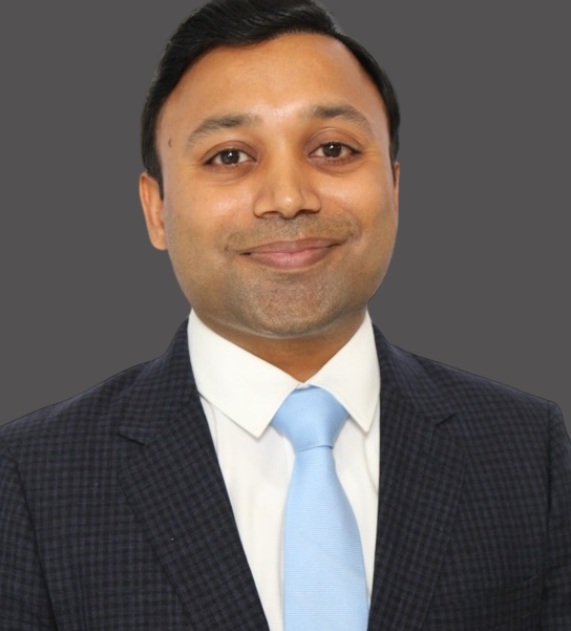
Chief Commercial Officer
Nihit Bhargava is a transformation and change management leader with experience in aligning technology, governance, and business strategy. With leadership roles at Meta (Facebook), Deutsche Bank, and Farragut Systems, he has led global programs across privacy, risk, AI enablement, and operational transformation.
Nihit has driven initiatives in product governance, third-party risk, regulatory compliance, and AI-driven automation, working closely with engineering and data teams to build scalable controls and intelligent reporting frameworks that reduce manual effort and enhance transparency.
He specializes in responsible AI adoption, model risk management, and workflow modernization using data-driven insights.
Nihit holds an MBA from the University of North Carolina’s Kenan-Flagler Business School and is passionate about applying AI to create sustainable enterprise impact.

Address:
Regus, Logix City Centre, Plot No. BW-58,
7th Floor, Sector 32,
Noida, UP-201301, India
Phone:
+91-9818324773
Email:
connect@gridsevenai.com
Address:
Grid Seven AI LLC
30 W 63rd Street
11F
New York, NY 10023, USA
Phone:
+1 (917) 902-0007
Email:
nihit@gridsevenai.com